Saturday, May 31, 2008

O Brother Where Art Thou


O Brother Where Art Thou is a more lighthearted Coen Brothers film that contains many of the Coen’s elements that are included in most of their films. The basic plot of the film is there are three men on a chain gang who try and break out of it in pursuit of some money. They encounter many obstacles along their way and the story almost follows the plot of the Odyssey. We know from previously watched Coen films that money often plays a big role in their films and that element remains constant here as well. One other element that is also in this film is the presence of an ultimate evil which here is a badass sheriff who is chasing the three men.
The idea of money has been a very strong motivation for the behaviors of characters in all of the Coen brother’s films we have seen. In Raising Arizona HI is a struggling criminal who is trying to raise and support a family but is in need of money so he feels it is necessary to rob convenience stores to help his family. In Fargo Jerry has a rich father in law and isn’t doing that well himself so he sets up a scheme to get his wife fake kidnapped to try and get a ransom from his father in law. This plan backfires when the two men get greedy and commit a few murders to try and get more of the money for themselves. Then in No Country for Old Men most of the main characters are all going after some drug money and that motivates mainly the antagonist, Anton to murder anyone who gets in his way of the cash. And then finally in O Brother Where Art Thou the three men lead by Everett break out of the chain gang that they are in, in pursuit of 1.2 million dollars. Everett told the men in the chain gang that before he was put in it he stole the money and was able to hide it before being captured by the law. This pursuit of the fortune gets the men in all sorts of trouble and motivates them to do things they normally wouldn’t.
The presence of an ultimate evil shows up in all of the Coen brothers films that I have seen. First in Raising Arizona the ultimate evil is represented with a biker, Leonard Smalls. This guy does not have any regard for any living creature and we can especially see this as he blows up an innocent bunny rabbit on the side of the road with a hand grenade. Then in Fargo Gaear Grimsrud is the badass of the film. This German beast will do anything even through his partner in a wood grinder to get more money. In No Country for old men Anton Chigurh is a ruthless killer. It doesn’t matter who you are he believes that if you are in his way you are destined to be killed. And then in O Brother Where Art Thou the unstoppable evil is a character named Sheriff Cooley. Cooley matches the description that one of the characters in the film gives of the devil and the sheriff will stop at nothing to catch and kill Everett and his men. He does not have any regard for the law, as a sheriff he does what he wants and we can see this at the end of the film when the three men get pardoned on the radio and Cooley still tries to hang them.
All of the Coen brothers’ films that I have seen seem to always contain these two elements. They really like the idea of money motivating people to do things they would normally not do and they also love to include a complete badass character to cause problems for our protagonist. The Coen brothers definitely have created there own well defined style and you will always be able to identify their perfection in any one of their films.

Monday, May 5, 2008

Coen Brothers

The Coen brothers are two exceptional directors that have their own distinct style. One recurring theme that we see with all of their films that we watched was the presence of an ultimate evil. In Raising Arizona there is a badass biker named Leonard Smalls who destroys everything in his path. In Fargo the ultimate evil is a big German named Gaear and he will do anything to get as much money as possible. Then in No Country for old men Anton is the ultimate evil and he is just a cold blooded killer who shows no remorse for anyone. The Coens seem to like to include a character like this in all of their films and with these characters is is simple to see who the bad guy is.
Another thing that is very important to the plot of all of the Coen brother's films is the use of money. Money is used as an incentive to commit crimes and cause problems. We see this a little bit in Raising Arizona how HI needs to rob a convenience store to support his family. Then in Fargo it is an incentive for everyone and it is the cause of many deaths. And in No Country everyone is after the couple million dollars and in the end most people are dead. Money and greed are very evident in all of the Coen's films and it just goes to show us that nothing good ever comes from greed.

Sunday, April 20, 2008

Altman

Robert Altman is a very unique director with a few styles that are very different from other directors. There is one cinematic element that he seems to include in all of his films that he is well known for. He seems to always have a restless camera that is always moving around. We see this in most of his films especially in the beginning of the player where we get to start out with a nice long eight minute tracking shot. These types of shots are great ways to start out a film and kind of show the viewer what the setting is like and give them an idea of what they should expect to see.
Another very common element in Robert Altman films is that they all seem to include some sort of satire. He seems to like to always make a statement about a certain subject and he really shows how he feels in all of his films. In The Long Goodbye he uses Marlowe to make tons of fun of the 70s decade. Then in Nashville he relentlessly rips on country music down south. And then in the Player he makes fun of Hollywood and shows us some of the ridiculous thing that can take place there. Robert Altman has a very unique style but it is one that makes his movies stand out and represent great ideas.

Wednesday, March 19, 2008

Kurosawa

Kurosawa is a very interesting director that likes to use certain elements of film very frequently. One thing that he does in all of the films that we watched is that he adds long sequences with only nondiegetic sound. He will do this to make something stand out or tell the story without dialogue. We especially see this in Stray Dog with the enormously long 15 minute sequence in the black market. We also see one of these sequences in Ran where there is dreary music playing and we see many dead bodies, and then all of a sudden there is a diegetic sound of the gunshot on Hidetora's son. Kurosawa is a master of this technique and has used it to add more meaning to his films.
Another repeated thing that we see in Kurosawa's films is the importance of the use of guns. In Stray Dog the whole conflict appears because of a stolen gun in the beginning of the film. Then in Yojimbo one person has a gun and that makes him stand out as a major enemy to the protagonist. And then guns are especially important in Ran because they represent something that brings about death and destruction to the human race. Kurosawa has a very strong opinion with guns and we can see that he fells that guns only cause problems and lead to death and murder.

Monday, March 10, 2008

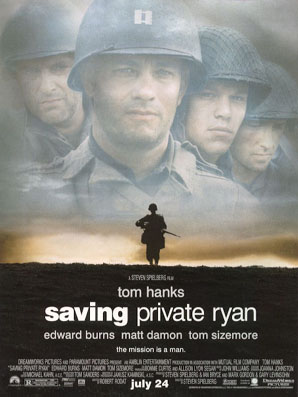
Saving Private Ryan


Saving Private Ryan was probably one of Speilberg's greatest films. It tells a great story of a team of solders and their captain with a mission to rescue Private Ryan whos brothers have all died. There is a huge theme and conflict in this film that deals with risking the lives of many men for just one man. The reason that it is so important to save Private Ryan in the film is mainly for his mother so she doesn't have to suffer the loss of all four of her sons. I remember when the higher ranked officers made the call to attempt to save ryan that I asked out loud "why is Ryan so important?" I really disagree with the decision, I understand that the mother would be sad but this mission is risking the lives of many other men who have mothers and families as well. To me the risk is to great to save just one man.

There is one very important scene in the film that deals with the theme of the movie. It is somewhere in the middle of the film when Captain Miller, played by Tom Hanks is discussing why their team should risk their lives for Private Ryan. Miller talks about how when one of his men dies he rationalizes it with the idea that that one death probably saved 20 others. But when a few of thier men die on this mission Miller breaks down because he has lost multiple men all to just save one. It seems like all of the men are doubting this mission but Captain Miller obeys his superiors and they continue with their orders.

Thursday, February 28, 2008

Hitchcock Post

There is an important theme of marriage that appears in most of the Hitchcock films. Through the plot of the films we get a sense that marriage is something to be mocked and made fun of. We can especially see this in Rear Window where Jeff is avoiding the beautiful Lisa who really wants to marry him. In order to get his attention she has to put herself in great danger which is pretty extreme over marriage. Also we see marital problems with all of his neighbors and with them and Jeff we can see how Hitchcock really dislikes the idea of marriage.
Another very common thing that we see in most of his movies are people who see things that they shouldn't. They act like peeping toms and because of this they get in some enormous trouble that is way over their heads. In rear window Jeff is bored and because of this he decides to watch his neighbors all the time. He then witnesses a murder and gets himself in some danger while trying to solve the murder. And then in Vertigo Scottie is hired to follow his friend's wife wherever she goes and he ends up falling in love with her, but then she "dies" and he ends up getting caught up in a murder situation as well. With these two films we see Hitchcock's message that one should not get into other peoples business and that it only leads to trouble.

Monday, February 25, 2008

Catch me if you can

Catch me if you can is based on the true story of a boy named Frank who became a master of checking fraud at a very early age. Frank, played by Leonardo DiCaprio is being pursued by Carl, an FBI officer played by Tom Hanks. The story of this chase contains one huge theme of truth in it. Frank is a con man and the way he makes his millions of dollars is simply by being an extremely good liar. He is able to pass himself off as a pilot, lawyer, and even a doctor. Frank and Carl have an interesting relationship where Frank will evade Carl and then Carl will catch up to Frank only to have him barely slip away each time. They have a tradition of always talking to each other on Christmas and with all of the conversations they have had they get to know each other a little. By analyzing Carl Frank makes an assumption that Carl also uses lying as a thing to help attain what he wants as well which in this case is to catch Frank, but as the movie goes on Carl is not what he seems and Frank gives in to the truth.
There is a very important scene toward the end of the movie which is one of the last standoffs between Frank and Carl. Carl walks into Frank's hideout unarmed and tells him that there are 20 French police cars outside and that he has been caught. Frank immediately reacts to this and tells Carl that he is full of shit. He has used so many lies in the past couple of years and has come to believe that they are used by everyone and that he can not trust anybody. These two have gotten to know each other over the last couple of years and it seems that they do care for one another. Carl says that Frank will die if he walks out of the warehouse and finally Frank believes him after making him swear on his daughter. The scene ends with the two of them walking out of there peacefully. After this scene we can see that Frank symbolizes lies and Carl is the truth. The movie sends a message to us that one can not lead a life of lies and eventually our lies will catch up to us.

Wednesday, February 13, 2008

War of the Worlds


War of the Worlds was directed by Steven Spielberg and deals with the question, what is aliens attacked us? Spielberg explores this idea and shows us how he thinks people would react to such a situation. It is interesting to see what everyone does when they see the destructive tripods. In the very beginning people are just very confused and dumbstruck, they just stand still and stare. But then when the aliens start firing their vaporizing lazers everybody erupts in a storm of panic. Spielberg shows everyone as throwing all of the rules away and doing anything to survive when this enormous disaster strikes. If such a disaster were to happen today in real life, it probably wouldn't be an alien invasion, but would people react in such a way? In the film Tom Cruise's character, Ray is trying desperately to get to Boston with his two kids as they cross through a very dense crowd of people trying to do the same thing in just about the only working car due to an electrical storm. The mob crowds the car screaming for a ride. They break the windows and an enormous fight breaks loose. Ray loses the car to someone with a gun and one person even gets shot and killed over the car. It is crazy how people in a mob react when such a disaster occurs and scary to think that something like that can turn good people into monsters fighting for every chance of survival.

One of the very last scenes of the movie still really confuses me. In the scene the camera zooms in on I think it is a leaf at first but it keeps zooming in on the leaf until we see the basic atoms and elements that make up the leaf. While they do this they explain what killed all of the alien tripods. They say that as soon as the aliens landed here they were doomed. They say that it is our life that has killed all of the tripods. I think this is very ridiculous, are the aliens allergic to us or what? How can such a sophisticated creature with this amazing technology just die? Ray defetes one of the many tripods, makes it to Boston, and somehow they are safe and the humans have won the war. I hated the ending, but am still confused. Maybe I am missing something and if someone could clarify the ending that would be great.

Friday, October 19, 2007

Pan's Labyrinth


Pan's Labyrinth is the story of a little girl, Ofelia who accepts a quest in order to become the rightful princess that she should be. Her and her mother move in with an evil man, Vidal in the middle of a big war in Spain. One day Ofelia wanders off and finds a labyrinth where she meets a faun and some fairies. The faun gives her three tasks to complete that will test her to see if she will be able to serve as princess of this magical other world. She needs to complete these tasks before the full moon, but she runs into some obstacles such as her pregnant mother and the evil Vidal who is leading the big war. The war is a whole different story that conflicts a little with Ofelia and her quest, but for the most part is not related. This part deals with the conflict of Vidal and Mercedes, who works for Vidal but is really undercover for the people Vidal is fighting. When Ofilia's mother dies Mercedes is the one who takes care of her. Carmen, Ofilia's mother was pregnant with her and Vidal's son and they are able to save the son before she dies. Vidal is obsessed with having his son and doesn't care about anyone else. It is the son who in the end of the film ties in the war segment and Ofelia's quest to complete her tasks. This was a great movie with some amazing imagery and imagination from the director and other creators of the film.
The director of the film is Guillermo Del Toro. He is very interested in fairy tales and has a great imagination. All of the imagery and characters are amazing in this film. They are fairytale but not the kind that you would normally think of. They have a very dark feel to them, from the giant frog to the evil monster with eyes in his hands. Even the faun who is good and helps Ofelia looks extremely dark and evil. Guillermo's imagination was influence by fairytale authors Arthur Rackham, Kay Nielson, and Edmund Dulac. It is with these author's illustrations and his own imagination that Del Toro was able to create these amazing fairytale creatures.
Along with having a great director this film also had some great actors. Sergi Lopez played the villain, Vidal who was a horrible and very violent man. Sergi captured Vidal's controlling and evil personality perfectly making him seem like a very real person. Lopez loves acting and has done it all of his life. He was born in Vilamova which is a small village near Barcelona. He had his own acting troupe there and then went on to study acting even more in Paris. It was there that he started his career with a role in La Petite Amie D'Antonio. As he continued acting he became known to play dark roles as the villain of the film. He acted in many films that all led up to his greatest role of Vidal the villain. Another very interesting actor in this film is Doug Jones. He played the role of the faun in Pan's Labyrinth and did so in a different way. Doug was born in 1960 in Indianapolis, IN. He studied acting and miming at Ball State university in Indiana. He played in many other movies before Pan's Labyrinth, most notably in Batman Returns. To play the role of the faun he need only to mime him. Jones just moved his body while a puppeteer moved his head. These two great actors really helped make the film very interesting and real.
Pan's Labyrinth is a very creative and interesting film. Even though it is in Spanish you can understand and enjoy its creative plot. The great director Guillermo Del Toro really helped make this fairytale like movie into an amazing work of art. Also the great actors contributed in helping to make the story come to life. Pan's Labyrinth was an amazing film and if you haven't seen it I would recommend watching it right away.

Monday, October 8, 2007

article reflection

This article has a lot of interesting things to say about westerms. It talks about how the western was struggling for a period of time and almost died out. It is certainly less popular today than it was back in the mid-90s, but films like 3:10 to Yuma have kept it alive. The western has also changed alot from when it was originally popular. In attempts to acheive a greater audience westerns now will contain more modern ideas like the issue of Iraq. The appeal to most people is that westerns are very natural, what you see on the screan was really acted out and there is not much fancy technology to alter the film. Westerns are making a comback and don't plan on dying out any time soon.

Tuesday, October 2, 2007

Pulp Fiction Review

I chose to watch and review the film Pulp Fiction, directed by Quentin Tarantino. There are many great actors in this film such as John Travolta, Samuel L. Jackson, Uma Thurman, Harvey Keitel, Tim Roth, Amanda Plummer, Maria de Medeiros, Ving Rhames, Eric Stoltz, Rosanna Arquette, Christopher Walken, and of course Bruce Willis. The screenplay was written by Quentin Tarantino and Roger Avary. The director of photography was Andrzej Sekula, and Karen Rachtman was in charge of the music. The producer of the film was Lawrence Bender. And finally the editor was Sally menke, and the costume designer was Betsy Heimann.
This movie greatly reminds me of another great movie, Sin City. Both movies have almost the exact same format. In both films there are three stories that take place during the course of the whole story. Not all of the main characters interact with each other but we can see as the film goes on how each story is related to one another very closely. The setting of Pulp Fiction is in California and mostly in Hollywood. There are five main characters in this film. First there are Vincent and Jules who are two gangsters working for another main character, Marcellus, who is kind of the head gangster. Then there is Mia who is Marcellus' wife, but who also falls a little bit for Vincent. Then finally there is Butch, who is a boxer who crosses Marcellus and has a big fight with him. There is not just one main source of conflict, there is one for each of the three stories that is told in the film. The first story is about Vincent and Mia. The conflict is for Vincent to try and take Mia out with him to a nice dinner, keep her safe and happy and return her to Marcellus unharmed. He encounters some problems though with some drugs and must think quickly just to keep her alive. Next we have the conflict between Butch and Marcellus. During a boxing match Butch killed his opponent when he won the match, but this upset Marcellus who began to chase Butch. Butch received a very important watch that got him into trouble with Marcellus and almost killed. The third story is with Vincent and Jules, who get into some trouble with some people that they have killed. The conflict is them struggling to stay out of trouble but also for Jules who is now starting to realize that what they are doing is wrong. These three stories and conflicts get intertwined with each other and work together to create this great masterpiece.
The Plot of Pulp Fiction is very complicated and can be very confusing to the viewer at times. It is probably realistic for a small portion of people who are involved with the world of crime. they would probably use the same language and act very similar to the characters in the film. This film had some very big names in it to capture each character perfectly. John Travolta portrayed Vincent, the gangster who didn't have any morals whatsoever perfectly the way he made his character not seem to care at all if someone died or even if he almost died. Samuel Jackson and Bruce Willis also portrayed their characters perfectly and made the film seem very real with all of the great acting. A theme that i saw in the movie was the challenge of overcoming evil. This applies mainly to Jules who realizes that he can't just kill people through a moment of clarity in the coffee shop, but also to Butch who takes a big step by helping out Marcellus even though they are trying to kill each other. One very important symbol in the second part of the story with Butch is his gold watch that he owns that used to be his father's. This watch is extremely important to Butch which we see in a flashback and symbolizes something to fight for and a reason to keep going for Butch as he goes through a hard time in his life with boxing and his fight with Marcellus. But the gold watch also symbolizes a big conflict that is about to happen when Butch goes back to his apartment to get it and finds Vincent waiting for him. The sets and costumes really helped set the time period witch seemed like it was back in the seventies. There had to be a lot of make-up used in the multiple bloody scenes. Also at one point in the story Vincent and Jules have to change out of their suits into T-shirts and shorts. When this happens it makes them look ridiculous and it makes them seem less powerful. There were many camera movements used in this film. Most of the movement was tracking to capture all of the action in the film, but there was also some tracking and pan shots included as well. There were also many close-ups used in the film. Some important ones were close-ups of the needle before the shot of adrenalin was administered, Vincent and Mia's handshake for the secret that they would each keep, and when Butch slowly opens his apartment door with his key. There is almost always a low angle on Vincent and Jules to show how powerful and important they are. Also there is a high angle shot of Butch and Marcellus when they are strapped to chairs to show how weak and helpless they are at that time. There are many deep focus shots used to show the viewer everything that is happening in a scene. One important instance is when Butch and Marcellus are tied up like I mentioned a second ago, you can see them tied up and also what their capturer is doing in the background. There is a nice distorted image when Vincent takes some drugs and decides to drive home while he is high. I noticed in the restaurant there were many quick cuts back and forth to Vincent and Mia while they were having a quickly moving conversation. Also there was a fade out when a story would end and a fade in when one would begin. When Vincent meets Mia there is some happy non-diegetic music playing to show that the two people will probably like each other and get along. And then later there is some diegetic sound with the dance music that Vincent and Mia dance along to.In Pulp fiction there are tons of elements of film that help make this a great movie. From the great acting to the amazing cinematic effects every second of this film is a masterpiece.

Monday, September 17, 2007

The Prestige Journal


I chose to review a review of the Prestige off rottentomatoes. The review I read was by David Ansen from Newsweek. This is a story of a rivalry between two great magicians. Each one of them are always creating new tricks that just fuel the rivalry between them and it forces them to keep outdoing each other. Ansen believes that the film is very clever with all of the twists and turns that it has to offer. I completely agree with him, one of the reasons I love this movie is that it always keeps you guessing and it will keep you wanting more. Ansen mentions that there are three huge twists in the film.
At the end of this dark entertainment three twists await: one you will certainly see coming, another you may have figured out just before it happens, and the final may be so tricky you won't quite piece it all together until after you've left the theater (the "explanation" whizzes by so fast it can be hard to catch.) Take the movie's first words to heart: watch closely. You'll be well rewarded.
These three twists in my opinion make the film amazing. You see the first twist and you think to yourself, yes I saw that coming. Then you see the next one and you think, wow that was sweet and I never would have guessed that. But then at the end of the movie you are kind of confused with the last one and and you can't stop thinking about what happened. I myself have my own theories about it and I argue with others who have seen the movie about what really happened. Ansen also calls the movie dark in his quote and I could not agree more. I think there are multiple things that make this movie very dark. First Borden, the more skillful magician causes the death of Angier's, the other magician, wife. Ansen thinks that Borden may have tied the knot in the trick that killed her a little to tight on purpose, but I disagree. I think that it was a complete accident even though it benefited Borden. This event would be the spark to ignite the huge rivalry between the two magicians. That is a pretty dark beginning to the movie but the darkest part of the film doesn't come till much later. In efforts to top Borden, Angier voyages to the U.S. to find a machine that does "real magic." This machine allows him to do an amazing trick, but at a horrible cost. I won't say exactly what the machine does, but it causes a sickness in your stomach that leaves you thinking about it all night.
Ansen describes Angier as being very sophisticated and describes Borden as more working class. He also says that Borden seems like kind of a bully and someone that will go to all lengths to become a great magician. I agree that Angier is more upper class than Borden, but I don't really think Borden seems much like a bully. I think that Borden is portrayed more as the "good guy" and someone who will make tremendous sacrifices for a great trick. At the end of Ansen's review he mentions the pledge, the turn, and the prestige. This is a big idea that gets us started with the movie, these are the components of a great trick. Ansen also mentions a question posed at the beginning or the film, "are you watching closely?" These are two things that are very important and if anyone was to go see the movie they need to definitely keep those in mind. I have agreed with most of Ansen's ideas other than a few, and I would recommend this movie to anyone, but if you decide to see it just make sure that you are in fact watching closely.

Wednesday, September 12, 2007

Bruce Almighty Clip

I chose to show a clip in Bruce almighty where Bruce decides to get back at his rival, Evan by making him say ridiculous things by using his powers. A medium shot is used to show all of the characters so we can see what is going on very easily. There is a low camera angle used on Bruce at one point when he is using his powers to type what he wants on an invisible keyboard. This makes him look powerful and superior to all of the other people. This is a great movie and one of the funniest parts of any movie that I have ever seen.

Monday, September 10, 2007

Happy Gilmore review


The movie Happy Gilmore is probably my favorite movie ever. It is a story about a hockey player who becomes a pro golfer to try to make enough money to buy back his grandmother's house.I agree with the movie review I read and think that this movie is hilarious with all of the great characters and the outrageous things that they say. This is one of the funniest movies that I have ever seen and if you have not seen it yet then you should rent it as soon as possible.


Photo courtesy of www.publispain.com/posters/happy_gilmore.jpg