Saturday, May 31, 2008

O Brother Where Art Thou


O Brother Where Art Thou is a more lighthearted Coen Brothers film that contains many of the Coen’s elements that are included in most of their films. The basic plot of the film is there are three men on a chain gang who try and break out of it in pursuit of some money. They encounter many obstacles along their way and the story almost follows the plot of the Odyssey. We know from previously watched Coen films that money often plays a big role in their films and that element remains constant here as well. One other element that is also in this film is the presence of an ultimate evil which here is a badass sheriff who is chasing the three men.
The idea of money has been a very strong motivation for the behaviors of characters in all of the Coen brother’s films we have seen. In Raising Arizona HI is a struggling criminal who is trying to raise and support a family but is in need of money so he feels it is necessary to rob convenience stores to help his family. In Fargo Jerry has a rich father in law and isn’t doing that well himself so he sets up a scheme to get his wife fake kidnapped to try and get a ransom from his father in law. This plan backfires when the two men get greedy and commit a few murders to try and get more of the money for themselves. Then in No Country for Old Men most of the main characters are all going after some drug money and that motivates mainly the antagonist, Anton to murder anyone who gets in his way of the cash. And then finally in O Brother Where Art Thou the three men lead by Everett break out of the chain gang that they are in, in pursuit of 1.2 million dollars. Everett told the men in the chain gang that before he was put in it he stole the money and was able to hide it before being captured by the law. This pursuit of the fortune gets the men in all sorts of trouble and motivates them to do things they normally wouldn’t.
The presence of an ultimate evil shows up in all of the Coen brothers films that I have seen. First in Raising Arizona the ultimate evil is represented with a biker, Leonard Smalls. This guy does not have any regard for any living creature and we can especially see this as he blows up an innocent bunny rabbit on the side of the road with a hand grenade. Then in Fargo Gaear Grimsrud is the badass of the film. This German beast will do anything even through his partner in a wood grinder to get more money. In No Country for old men Anton Chigurh is a ruthless killer. It doesn’t matter who you are he believes that if you are in his way you are destined to be killed. And then in O Brother Where Art Thou the unstoppable evil is a character named Sheriff Cooley. Cooley matches the description that one of the characters in the film gives of the devil and the sheriff will stop at nothing to catch and kill Everett and his men. He does not have any regard for the law, as a sheriff he does what he wants and we can see this at the end of the film when the three men get pardoned on the radio and Cooley still tries to hang them.
All of the Coen brothers’ films that I have seen seem to always contain these two elements. They really like the idea of money motivating people to do things they would normally not do and they also love to include a complete badass character to cause problems for our protagonist. The Coen brothers definitely have created there own well defined style and you will always be able to identify their perfection in any one of their films.

Monday, May 5, 2008

Coen Brothers

The Coen brothers are two exceptional directors that have their own distinct style. One recurring theme that we see with all of their films that we watched was the presence of an ultimate evil. In Raising Arizona there is a badass biker named Leonard Smalls who destroys everything in his path. In Fargo the ultimate evil is a big German named Gaear and he will do anything to get as much money as possible. Then in No Country for old men Anton is the ultimate evil and he is just a cold blooded killer who shows no remorse for anyone. The Coens seem to like to include a character like this in all of their films and with these characters is is simple to see who the bad guy is.
Another thing that is very important to the plot of all of the Coen brother's films is the use of money. Money is used as an incentive to commit crimes and cause problems. We see this a little bit in Raising Arizona how HI needs to rob a convenience store to support his family. Then in Fargo it is an incentive for everyone and it is the cause of many deaths. And in No Country everyone is after the couple million dollars and in the end most people are dead. Money and greed are very evident in all of the Coen's films and it just goes to show us that nothing good ever comes from greed.

Sunday, April 20, 2008

Altman

Robert Altman is a very unique director with a few styles that are very different from other directors. There is one cinematic element that he seems to include in all of his films that he is well known for. He seems to always have a restless camera that is always moving around. We see this in most of his films especially in the beginning of the player where we get to start out with a nice long eight minute tracking shot. These types of shots are great ways to start out a film and kind of show the viewer what the setting is like and give them an idea of what they should expect to see.
Another very common element in Robert Altman films is that they all seem to include some sort of satire. He seems to like to always make a statement about a certain subject and he really shows how he feels in all of his films. In The Long Goodbye he uses Marlowe to make tons of fun of the 70s decade. Then in Nashville he relentlessly rips on country music down south. And then in the Player he makes fun of Hollywood and shows us some of the ridiculous thing that can take place there. Robert Altman has a very unique style but it is one that makes his movies stand out and represent great ideas.

Wednesday, March 19, 2008

Kurosawa

Kurosawa is a very interesting director that likes to use certain elements of film very frequently. One thing that he does in all of the films that we watched is that he adds long sequences with only nondiegetic sound. He will do this to make something stand out or tell the story without dialogue. We especially see this in Stray Dog with the enormously long 15 minute sequence in the black market. We also see one of these sequences in Ran where there is dreary music playing and we see many dead bodies, and then all of a sudden there is a diegetic sound of the gunshot on Hidetora's son. Kurosawa is a master of this technique and has used it to add more meaning to his films.
Another repeated thing that we see in Kurosawa's films is the importance of the use of guns. In Stray Dog the whole conflict appears because of a stolen gun in the beginning of the film. Then in Yojimbo one person has a gun and that makes him stand out as a major enemy to the protagonist. And then guns are especially important in Ran because they represent something that brings about death and destruction to the human race. Kurosawa has a very strong opinion with guns and we can see that he fells that guns only cause problems and lead to death and murder.

Monday, March 10, 2008

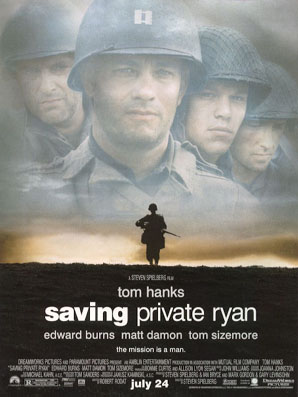
Saving Private Ryan


Saving Private Ryan was probably one of Speilberg's greatest films. It tells a great story of a team of solders and their captain with a mission to rescue Private Ryan whos brothers have all died. There is a huge theme and conflict in this film that deals with risking the lives of many men for just one man. The reason that it is so important to save Private Ryan in the film is mainly for his mother so she doesn't have to suffer the loss of all four of her sons. I remember when the higher ranked officers made the call to attempt to save ryan that I asked out loud "why is Ryan so important?" I really disagree with the decision, I understand that the mother would be sad but this mission is risking the lives of many other men who have mothers and families as well. To me the risk is to great to save just one man.

There is one very important scene in the film that deals with the theme of the movie. It is somewhere in the middle of the film when Captain Miller, played by Tom Hanks is discussing why their team should risk their lives for Private Ryan. Miller talks about how when one of his men dies he rationalizes it with the idea that that one death probably saved 20 others. But when a few of thier men die on this mission Miller breaks down because he has lost multiple men all to just save one. It seems like all of the men are doubting this mission but Captain Miller obeys his superiors and they continue with their orders.

Thursday, February 28, 2008

Hitchcock Post

There is an important theme of marriage that appears in most of the Hitchcock films. Through the plot of the films we get a sense that marriage is something to be mocked and made fun of. We can especially see this in Rear Window where Jeff is avoiding the beautiful Lisa who really wants to marry him. In order to get his attention she has to put herself in great danger which is pretty extreme over marriage. Also we see marital problems with all of his neighbors and with them and Jeff we can see how Hitchcock really dislikes the idea of marriage.
Another very common thing that we see in most of his movies are people who see things that they shouldn't. They act like peeping toms and because of this they get in some enormous trouble that is way over their heads. In rear window Jeff is bored and because of this he decides to watch his neighbors all the time. He then witnesses a murder and gets himself in some danger while trying to solve the murder. And then in Vertigo Scottie is hired to follow his friend's wife wherever she goes and he ends up falling in love with her, but then she "dies" and he ends up getting caught up in a murder situation as well. With these two films we see Hitchcock's message that one should not get into other peoples business and that it only leads to trouble.

Monday, February 25, 2008

Catch me if you can

Catch me if you can is based on the true story of a boy named Frank who became a master of checking fraud at a very early age. Frank, played by Leonardo DiCaprio is being pursued by Carl, an FBI officer played by Tom Hanks. The story of this chase contains one huge theme of truth in it. Frank is a con man and the way he makes his millions of dollars is simply by being an extremely good liar. He is able to pass himself off as a pilot, lawyer, and even a doctor. Frank and Carl have an interesting relationship where Frank will evade Carl and then Carl will catch up to Frank only to have him barely slip away each time. They have a tradition of always talking to each other on Christmas and with all of the conversations they have had they get to know each other a little. By analyzing Carl Frank makes an assumption that Carl also uses lying as a thing to help attain what he wants as well which in this case is to catch Frank, but as the movie goes on Carl is not what he seems and Frank gives in to the truth.
There is a very important scene toward the end of the movie which is one of the last standoffs between Frank and Carl. Carl walks into Frank's hideout unarmed and tells him that there are 20 French police cars outside and that he has been caught. Frank immediately reacts to this and tells Carl that he is full of shit. He has used so many lies in the past couple of years and has come to believe that they are used by everyone and that he can not trust anybody. These two have gotten to know each other over the last couple of years and it seems that they do care for one another. Carl says that Frank will die if he walks out of the warehouse and finally Frank believes him after making him swear on his daughter. The scene ends with the two of them walking out of there peacefully. After this scene we can see that Frank symbolizes lies and Carl is the truth. The movie sends a message to us that one can not lead a life of lies and eventually our lies will catch up to us.

Wednesday, February 13, 2008

War of the Worlds


War of the Worlds was directed by Steven Spielberg and deals with the question, what is aliens attacked us? Spielberg explores this idea and shows us how he thinks people would react to such a situation. It is interesting to see what everyone does when they see the destructive tripods. In the very beginning people are just very confused and dumbstruck, they just stand still and stare. But then when the aliens start firing their vaporizing lazers everybody erupts in a storm of panic. Spielberg shows everyone as throwing all of the rules away and doing anything to survive when this enormous disaster strikes. If such a disaster were to happen today in real life, it probably wouldn't be an alien invasion, but would people react in such a way? In the film Tom Cruise's character, Ray is trying desperately to get to Boston with his two kids as they cross through a very dense crowd of people trying to do the same thing in just about the only working car due to an electrical storm. The mob crowds the car screaming for a ride. They break the windows and an enormous fight breaks loose. Ray loses the car to someone with a gun and one person even gets shot and killed over the car. It is crazy how people in a mob react when such a disaster occurs and scary to think that something like that can turn good people into monsters fighting for every chance of survival.

One of the very last scenes of the movie still really confuses me. In the scene the camera zooms in on I think it is a leaf at first but it keeps zooming in on the leaf until we see the basic atoms and elements that make up the leaf. While they do this they explain what killed all of the alien tripods. They say that as soon as the aliens landed here they were doomed. They say that it is our life that has killed all of the tripods. I think this is very ridiculous, are the aliens allergic to us or what? How can such a sophisticated creature with this amazing technology just die? Ray defetes one of the many tripods, makes it to Boston, and somehow they are safe and the humans have won the war. I hated the ending, but am still confused. Maybe I am missing something and if someone could clarify the ending that would be great.